Preservation of the collections: The former Museum der Natur Hamburg does not provide suitable accommodation for the valuable collection of over ten million items, a shortcoming which was highlighted by the German Science Council as far back as 2008. A modern infrastructure for international biodiversity and evolutionary research – in terms of size, ventilation, climate control, pest prevention and other factors – is long overdue. The current conditions jeopardise the long-term preservation of the collections.
Hamburg as a centre of science: The new Natural History Museum will be a major attraction in a prominent location and will serve as a special symbol of science and research in Hamburg. It is intended to enrich and consolidate Hamburg’s position as a centre of science.
The Leibniz Institute for Biodiversity Change Analysis (LIB) is home to outstanding scientists from 40 nations, all of whom are part of an international network. Many of them were also drawn here by the prospect of a new research museum. Any further delay would jeopardise the long-term development prospects for research in Hamburg and could make it more difficult to attract and retain highly qualified scientists.
A natural history museum with appeal: unlike other regions in Germany, Hamburg and its metropolitan area do not have a natural history museum with appeal. A city the size of Hamburg lacks a research museum that reflects our relationship with nature and fosters future-oriented debates on solving sustainability issues. The Hamburg Natural History Museum was destroyed during the Second World War and never rebuilt. Since then – and in light of today’s biodiversity crisis more than ever – there has been a lack of a prominent venue that inspires people with the diversity of nature and, through up-to-date facts and in a way that resonates emotionally, helps them understand what it means when animal and plant species are threatened with extinction due to human influence. A venue that illustrates the scale of this loss, makes us aware of our responsibility and highlights solutions is a gap in Hamburg’s museum landscape.
An extracurricular learning venue: a natural history museum, such as the one planned for Hamburg, is expected to bring hundreds of thousands of people into contact each year with issues relevant to our lives and survival; it will provide them with facts and involve them in the search for solutions to preserve our natural world. A natural history museum is a world of discovery for families and children – but above all, it is an out-of-school learning environment dedicated to the diversity of nature – which is particularly important at a time when knowledge of biological interrelationships and people’s connection to nature are dwindling.
A research museum such as the LIB’s Museum der Natur Hamburg is far more than just an exhibition venue. It preserves valuable collections and generates knowledge that helps to develop solutions for the conservation of nature. It is a research centre, a repository of knowledge and a vibrant public meeting place all at once.
Research museums such as those run by the LIB document and analyse changes in biodiversity, highlight interconnections, help to improve our understanding of nature and provide a framework for discussing future challenges from various perspectives. They are also institutions that make research findings accessible to policy-makers and have a voice in debates on nature conservation.
Through exhibitions, target-group-specific educational programmes and events, as well as digital formats offered by research museums, visitors from diverse backgrounds and with varied interests gain insights not only into scientific findings, methods and working practices, but also into unresolved research questions. At the same time, they contribute their own questions and observations, thereby enriching the dialogue on sustainability issues between different sections of society.
The new museum is to be an integrated research museum, centrally located in Hamburg, featuring research laboratories, collection storage facilities and a public area (exhibitions, educational and outreach programmes), where – even more so than at the current Museum der Natur Hamburg in the Grindelviertel – research will be conducted and visitors will be able to experience first-hand just how vital the protection of nature, biodiversity and the climate is to the survival of humanity. A key strength lies in the ability of modern natural history museums to translate complex topics, such as the loss of biodiversity and its consequences, into immersive, accessible and memorable experiences.
In the new building, cutting-edge international research into changes in biodiversity, the conservation and study of the collections, and the public exhibition areas will be closely interlinked.
The scientists are addressing key research questions of our time: How is climate change altering the distribution of species? What happens to ecosystems when species die out – and how does this affect us humans? What can we do to counter the biodiversity crisis and species extinction? What measures can we develop?
The new Natural History Museum is intended to be a vibrant place where people can discover the diversity of nature, experience science at first hand and engage in discussion about the major questions facing our society’s future. The result will be a place that not only imparts knowledge but also encourages reflection and collective action to preserve the natural foundations of our existence.
The new museum is to be built as an integrated research museum; this means that it will bring together various laboratories and technical rooms, workshops and collection storage areas, offices and seminar rooms, as well as the public area with exhibitions and various educational and event spaces.
The new building will bring together the three museums (Zoology, Mineralogy and Geology-Palaeontology), with their collections and research infrastructure as well as their exhibitions, under one roof. In addition, an education and events area is to be created where visitors can experience research first-hand.
As the current public areas have reached their capacity limits and several hundred thousand visitors are expected at the new museum, the exhibition will be larger and more interactive than before. Furthermore, spaces are to be created to support the scientific and social engagement of associations, initiatives and citizen scientists. The aim is to build a community in Hamburg centred on the theme of biodiversity.
The growing collections, which currently comprise more than ten million objects, also require a great deal of space.
The more than ten million items in the collection, which are currently spread across three storage facilities on the University of Hamburg campus, will be transferred to the new museum. They will be made available here for research purposes and, in part, to the public as well.
The exhibition will be redesigned in a fresh and contemporary style. Exhibits from the current exhibition will be presented in new contexts in the new building. Further exhibits and displays will be added.
In the long term, the buildings currently occupied by the Museum of Nature will largely be used by the University of Hamburg.
In 2021, as part of an intergovernmental agreement with the state of North Rhine-Westphalia on the establishment of the Leibniz Institute for the Analysis of Biodiversity Change (LIB), Hamburg undertook to build a natural history museum.
From the intergovernmental agreement, Article 7(2): (…) In particular, it is agreed that the Free and Hanseatic City of Hamburg will construct a new building for the Hamburg site within the next few years, which will bring together the city’s collections, workspaces and laboratories, as well as the exhibition and education areas, under one roof, and the costs of which are to be borne solely by the Free and Hanseatic City of Hamburg. (…)
The State Treaty continues to form the binding basis for the project. In 2021, the City Parliament also passed a unanimous resolution to build a new Natural History Museum in Hamburg.
In mid-October 2026, Hamburg’s First Mayor, Peter Tschentscher, together with Senator for Science Maryam Blumenthal and Senator for the Environment Katharina Fegebank, reaffirmed the decision to build a new natural history museum.
Since 2022, the Hamburg Senate has been assessing various sites for the new Natural History Museum. In doing so, particular consideration is being given to the spatial and technical requirements of an integrated research museum, as well as economic, transport and urban planning aspects.
On the basis of these investigations, the Hamburg Senate initially declared the Elbtower to be the preferred location option in October 2025. According to the findings at that time, the Elbtower offered the best conditions in terms of quality and cost-effectiveness amongst the options examined.
However, a final decision has not yet been made. Negotiations between the investor consortium and the insolvency administrator, as well as discussions with the City of Hamburg, are still ongoing. Only once the necessary information for a decision is available can the Hamburg Parliament make a final decision on the location.
In addition to the Elbtower, other sites were examined, including sites in HafenCity, Bahrenfeld and at the Besenbinderhof. The question of the location therefore remains open.
For the LIB, it is crucial that the new Natural History Museum meets the requirements for modern research, scientific collections, exhibitions and education. The spatial concept developed jointly with the city is not tied to any single property.
The Hamburg City Senate is in talks with the property consortium led by private investor Dieter Becken regarding the acquisition of around 46,000 square metres of floor space and a shared communal area within the Elbtower. The Natural History Museum would use the lower twelve storeys of the Elbtower – now planned to be 199 metres high – for its research facilities and public spaces. This would account for just under half of the total floor area. The Senate has set a fixed purchase price of 595 million euros for the turnkey Elbtower. The Leibniz Institute for the Analysis of Biodiversity Change is not involved in the purchase negotiations.
The museum’s running costs are covered by the Leibniz Association.
In the inter-state agreement with North Rhine-Westphalia, Hamburg has committed to establishing a new natural history museum. The new building is therefore part of a binding agreement to establish the Leibniz Institute for the Analysis of Biodiversity Change (LIB).
For the previously favoured location in the Elbtower, the Hamburg Senate had planned to finance the project through loans and funds from the special fund for infrastructure measures. The relevant political bodies will decide on the allocation and use of the necessary funds.
At the same time, the new Natural History Museum itself represents an investment in education and science. It is intended not only to provide modern facilities for research and the preservation of scientific collections, but also to become an important out-of-school learning venue for children, young people and adults.
The construction of a natural history museum involves what are known as ‘capital expenditure’, i.e. funds that are invested once, as opposed to ‘operating expenditure’, which refers to funds used for ongoing expenditure such as the salaries of teachers, teaching assistants, university places and other such purposes.
At present, the Hamburg Museum of Natural History – comprising the departments of Zoology, Mineralogy and Geology-Palaeontology, along with its collections, laboratories, technical and work rooms, and exhibitions – is spread across three locations on the University of Hamburg campus.
The need for suitable accommodation for the valuable collections, comprising ten million objects, was already highlighted by the German Science Council back in 2008. The current conditions jeopardise their long-term preservation. A modern infrastructure with suitable storage conditions – for example, in terms of climate control, ventilation and pest prevention – is urgently needed.
The collections are not only a valuable natural heritage but also an indispensable foundation for international biodiversity and evolutionary research. This requires modern laboratories, suitable workspaces and an infrastructure that meets scientific requirements. These conditions are not adequately met at the current locations.
Furthermore, with over 120,000 visitors annually, the exhibitions are reaching their capacity limits. There is a lack of space for contemporary exhibitions, diverse and inclusive educational programmes, and direct engagement between the scientific community and the public. The exhibitions can no longer meet the spatial and content-related requirements of a modern museum and exhibition building.
A natural history museum must be a place that everyone, regardless of their age or personal background, enjoys visiting, leaves feeling inspired, and returns to again and again. If the museum offers only a small public area or is too remote, these expectations cannot be met.
The new Natural History Museum is intended – to a greater extent than the current Museum der Natur Hamburg – to become an educational and event venue that conveys up-to-date knowledge on biodiversity in a vivid way, makes natural history research visible and accessible to a broad cross-section of the population, and provides a space for discussion. Inclusive and participatory formats, which promote learning through play, dialogue, hands-on experimentation and active participation, are being developed for different groups of visitors.
People of all ages, from children to adults, are to be holistically engaged here with the working methods and ways of thinking in research, the development of scientifically proven facts, and the critical analysis of data.
To help visitors develop ‘science literacy’, there will be activity areas with educational materials, as well as laboratories where visitors can conduct their own research. Collaboration with schools is planned, as is cooperation with initiatives, associations and citizen scientists.
A key focus of the new museum will be the promotion of taxonomic knowledge as the foundation for nature conservation. Young people, in particular, will be able to expand their knowledge of species and ecological relationships through courses, field trips and youth clubs. After all, you can only protect what you know. In the long term, the new museum is set to become a centre of excellence for species knowledge.
In the events area, social issues will be addressed and discussed from various perspectives with researchers and guests from society, politics, business and culture. Whether it is the race against species extinction, opportunities for species conservation or the importance of biodiversity in agriculture – for all these topics, findings from key LIB research fields and projects will be linked with questions from members of the public and contributions from stakeholders.
The LIB’s comprehensive biocultural collection is also set to play an important role in youth and adult education. The objects – such as hunting trophies and fashion items made from leather, fur or ivory – reveal, through the way they have been prepared, how animal groups are utilised, as well as societal values and role models, knowledge and perceptions. The objects are used, for example, in identification exercises with customs officers or at other events on species conservation.
The Hamburg Natural History Museum was destroyed during the Second World War. It was situated next to the main railway station and was once Germany’s second-largest natural history museum: an impressive building with a spacious exhibition.
The Natural History Museum was founded in 1843 by the citizens of Hamburg and moved to its new premises on Steintorwall in 1891.
Fortunately, parts of the collections were moved to safety and saved during the Second World War. They came into the university’s possession in 1969. With the establishment of the Centre for Natural History, the three university museums of Zoology, Mineralogy and Geology-Palaeontology were merged into a single operational unit, and the expansion of the scientific collections and the public areas was driven forward.
In 2021, the University’s Centre for Natural History was merged with the Alexander Koenig Zoological Research Museum in Bonn to form the Leibniz Institute for the Analysis of Biodiversity Change.
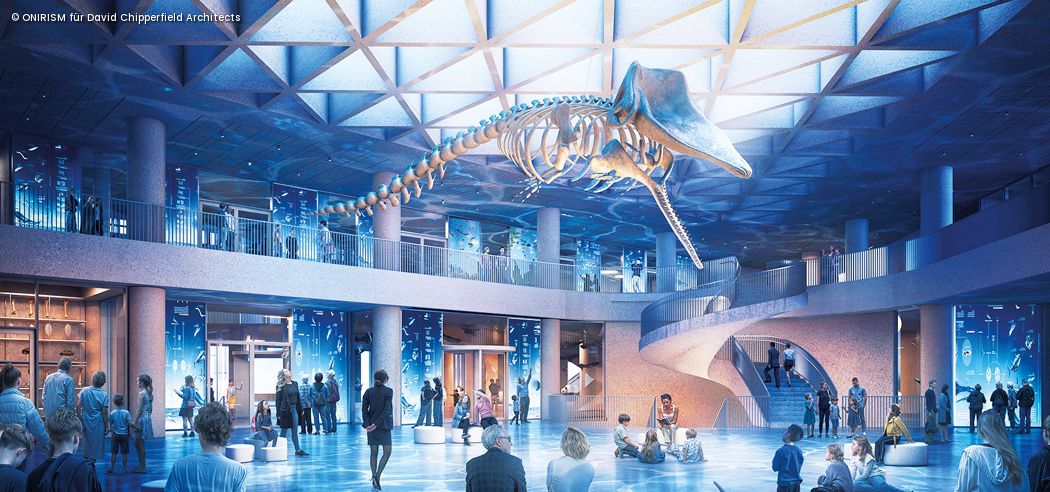
Why does Hamburg need a new (research) museum? What are the plans, what is the current status, and what significance does the project hold for the city and its residents? Here, we will be providing ongoing answers to the latest questions on this topic.
Privacy Settings
These cookies are necessary to enable the basic functions of our website.
This consent allows you to view external contents (via iframe).
This consent allows you to watch embedded videos.
Page views are recorded for statistical purposes using Matomo in order to constantly optimise our website. The visitor's IP address is pseudonymised.